

Waking Up Sore? Your Pillow and Sleep Position Might Be the Problem
One of the most common things we hear in a first visit goes something like this: I did not do anything to it. I went to bed fine and woke up barely able to turn my head. It feels unfair, and it feels random, but it is usually neither.
Waking up with neck pain or a stiff low back is one of the clearest signals that your sleep setup is working against you. You spend roughly a third of your life in one position, unable to adjust, with your head and spine held wherever your mattress and pillow decide to hold them. Very few of the aches we treat get as little attention as this one, and very few are as fixable.
Why eight hours in one position matters so much
During the day your body is constantly making tiny corrections. You shift in your chair, you stretch, you stand up, you roll your shoulders without thinking about it. Those small movements keep joints lubricated and muscles from settling into one shortened length.
At night that stops. If your head is propped four inches too high, the joints on one side of your neck stay compressed and the muscles on the other side stay stretched, hour after hour. If your mattress sags in the middle, your low back holds a curve it does not like for the whole night. Wake up, and the tissue has stiffened right where it was held. That first attempt to turn your head is when you find out.
Then there is the fact that most people are not starting from neutral. If you already have some upper back stiffness from a desk job, or a hip that does not move as well as the other one, a mediocre pillow is enough to tip you over. The night did not cause the problem. It exposed one that was already there.
Sleep positions, ranked honestly
We are careful about being too dogmatic here, because the best sleep position is one you can actually sleep in. Being told to switch to your back when you have slept on your stomach for forty years is not helpful advice. That said, the differences are real.
Back sleeping is generally the friendliest to the spine. Your weight distributes evenly and your neck can sit in a neutral position, as long as your pillow is not pushing your chin toward your chest. One pillow of moderate height under the head, and a pillow under the knees if your low back tends to ache, and most people do well.
Side sleeping is the most common and works fine with a little attention. The goal is a straight line from the back of your head down through your spine. That usually means a slightly thicker pillow than back sleepers need, filling the gap between your ear and the mattress. A pillow between the knees keeps the top hip from dropping forward and pulling on the low back. Broad shoulders often need more pillow height than people expect.
Stomach sleeping is the hardest on the neck, because your head has to rotate to one side for the whole night and stay there. If that is genuinely the only way you fall asleep, use a very thin pillow or none at all, and consider putting a slim pillow under your hips to take some strain off the low back. We would rather help you make stomach sleeping less rough than tell you to quit and have you ignore us.
How to tell if your pillow is the culprit
There is no magic pillow and no brand we push. What matters is height, and height depends on your position and your body. A few practical checks:
Have someone look at you from the side while you lie the way you actually sleep. Your nose should roughly line up over the middle of your chest, not tipped up or tucked down.
If you wake up with your hand tucked under your pillow or under your head, your pillow is probably too thin.
If you wake up with a sore shoulder on the side you sleep on, it may be too thin as well, since your shoulder is taking the load your pillow should.
If you get pain across the top of your shoulders and the base of your skull, too thick is the usual suspect.
If you can fold your pillow in half and it stays folded, it is finished. Foam and fiber both collapse over time.
Mattresses matter too, but they are a much bigger purchase, so start with the pillow. If your mattress has a visible dip where you sleep, or you sleep better in hotel beds than your own, that is your answer. Most mattresses have somewhere between seven and ten honest years in them.
What we do when someone comes in with morning stiffness
Our first job is to figure out whether sleep is the cause or just the trigger. Those are different problems and they get different plans.
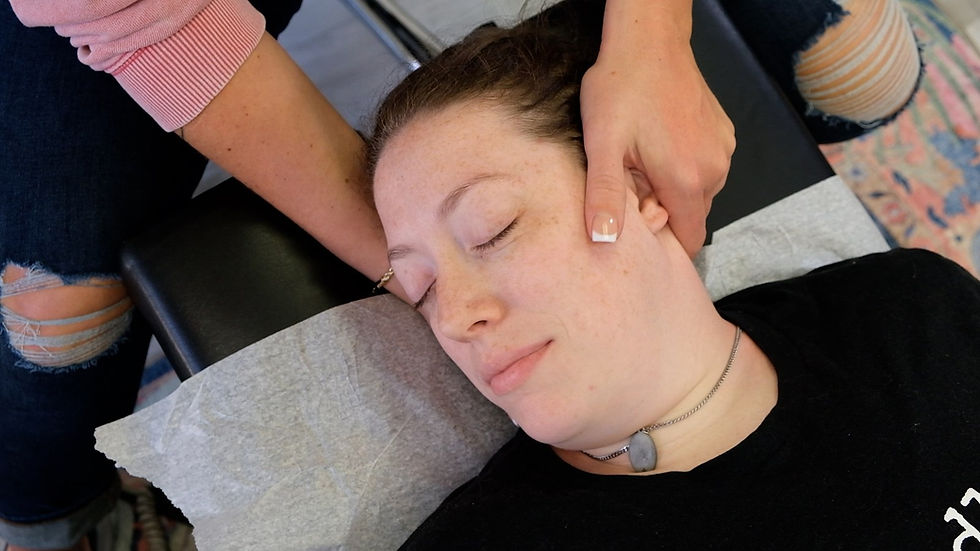
We start with your history, including what your nights look like, how long this has been going on, and whether it is the same spot every morning or moves around. Then we assess. Posture analysis, range of motion testing, soft tissue evaluation, and palpation, which is a skilled hands-on examination that lets us feel exactly which joints are restricted and which muscles are guarding. Morning stiffness that clears within twenty minutes of moving tells us something different than pain that follows you into the afternoon.
From there, care usually combines chiropractic adjustments to restore motion where it has been lost, soft tissue work on the muscles that have been holding tension all night, and a specific conversation about your sleep setup. Sometimes that means a different pillow height. Sometimes it means a pillow between the knees. Sometimes it means addressing a hip or shoulder restriction that is making your current position uncomfortable in the first place. We would rather fix the reason your body cannot tolerate the position than just tell you to change the position.
Fall in Rochester makes this worse before it makes it better
Late September is when the bedroom gets colder and people start curling up tighter under heavier blankets. Curled up means more rotation in the neck and more flexion in the low back, held longer. At the same time the school year has reset everyone's alarms earlier, so the sleep window shrinks and the body gets less time to recover from whatever the day put into it.
We also see the yard-work version of this. You spend a Saturday clearing leaves and hauling bags around the yard in Gates or Chili, sleep on it badly, and wake up Sunday wondering what happened. The yard work loaded the tissue. The night of poor positioning is what locked it in.
Small changes that pay off quickly
Move for two minutes before you get out of bed. Knees side to side, a gentle stretch, a few slow neck rotations. Do not go from dead still to vertical in one motion.
Do not fall asleep on the couch with your head on the armrest. Everyone does it, and it is one of the most reliable ways to wake up with a locked neck. Keep your phone off your chest at night too, because reading in bed with your chin tucked is the same position that causes trouble at a desk.
When to stop guessing and get it looked at
If you have woken up sore more mornings than not for a few weeks, or if the stiffness does not loosen up within half an hour of moving, or if you are getting numbness or tingling into an arm or leg, that is the point to have someone examine it. Persistent morning pain is worth a real assessment, not another pillow from the internet.
Lunt Chiropractic is a women-owned practice at 503 Beahan Road in Rochester, in the Westgate Woods Medical Complex near the airport, and we see patients from Gates, Chili, Greece, and across the west side. Our hours include early mornings, evenings, and Saturday mornings, so you do not have to burn a vacation day to be seen.
Call us at (585) 594-0026, email info@luntchiropractic.com, or book online at luntchiropractic.com. Bring your pillow questions. We get them all the time, and we like them.


Comments